
The government on Wednesday approved 12 new industrial cities in 10 states on the lines of Greater Noida in Uttar Pradesh and Dholera in Gujarat to boost domestic manufacturing with an estimated investment of Rs 28,602 crore. These industrial areas will be in Khurpia in Uttarakhand, Rajpura-Patiala in Punjab, Dighi in Maharashtra, Palakkad in Kerala, Agra and Prayagraj in UP, Gaya in Bihar, Zaheerabad in Telangana, Orvakal and Kopparthy in AP, and Jodhpur-Pali in Rajasthan, and one in Haryana. A decision in this regard was taken in a meeting of the Cabinet Committee on Economic Affairs chaired by Prime Minister Narendra Modi.

Schemes like the Mukhyamantri Majhi Ladki Bahin Yojana strain fiscal resources amid rising unemployment and prices of food items.
For 2017-18, the government aims to bring down the fiscal deficit to 3.2 per cent of GDP. Last fiscal, it had met the 3.5 per cent target.

While no specific state-oriented sops were rolled out, a strong thread of political wellness ran through the Budget.

'The nominal GDP growth assumption for FY25 may be revised upwards on higher growth expectations.'

Reminiscent of the past two years, the market has made positive strides ahead of the Union Budget 2023-24 (FY24). The benchmark National Stock Exchange Nifty has gained 1.8 per cent in the last month. Typically, markets tend to gain ahead of the Budget as investors build in optimism.

The final agriculture GDP numbers for 2016-17 are expected to be revised up, as rabi production is looking really good.
Fiscal deficit had soared to seven-year high of 4.6 per cent of GDP in 2019-20, mainly on account of poor revenue realisation which dipped further towards the close of March because of the lockdown.

'With new projects and recently awarded projects kicking in, capital expenditure should only increase going forward.'

The FMCG industry hopes for a revival in consumption growth in 2025 with some 'green shoots' already visible, after having a challenging year amid escalating input costs and a double-digit rise in food inflation, which ultimately slowed down the pace of the urban market growth in the second half of 2024. Soaring prices of commodities such as palm oil, coffee, cocoa and wheat forced FMCG players to go for a hike of 3 to 5 per cent or resort to shrinkflation by reducing pack sizes and grammage to retain attractive price points, fearing a volume loss.

Mumbai, which adds 37 per cent to the total direct tax mop-up, has reported tax collection of Rs 4.93 trillion so far, against the full-year target of Rs 5.35 trillion.

'If it doesn't, it will continue with measures to infuse liquidity, signalling a new cycle,' predicts Tamal Bandyopadhyay.

'We are getting to understand the mind of this generation.' 'Minor tweaks are being made to ease the process as we go along.'

Fiscal deficit for 2020-21 was at 9.3 per cent of the gross domestic product (GDP), lower than 9.5 per cent estimated by the finance ministry in the revised Budget estimates, according to the CGA data. Unveiling the revenue-expenditure data of the Union government for 2020-21, the Controller General of Accounts (CGA) on Monday said that the revenue deficit at the end of the fiscal was 7.42 per cent.

The Reserve Bank of India on Thursday kept the benchmark interest rate unchanged at 4 per cent and decided to continue with its accommodative stance against the backdrop of an elevated level of inflation.

'It is a balanced and prudent Budget that sets the foundation for future growth in the economy.'

'More a show that you are doing something in the Budget even if that something never actually comes to pass,' notes Nitin Desai.

Siddharth Roy Kapur's RKF aims to raise around $50 million by offering up to a 50 per cent stake in the company.

Amid a debate over 70-90-hour work week, the pre-Budget Economic Survey on Friday cited studies to state that spending over 60 hours a week on work could have adverse health effects. The survey noted that spending long hours at one's desk is detrimental to mental well-being and individuals who spend 12 or more hours (per day) at a desk have distressed or struggling levels of mental well-being.
The central government is likely to further consolidate its fiscal deficit by 50 basis points (bps) to 5.9 per cent in FY24 from 6.4 per cent in FY23, according to a recent report released by Goldman Sachs on Tuesday. In the current fiscal year, there is going to be an upside of 0.5 per cent on the receipts side due to higher nominal GDP growth, and higher tax buoyancy because of the formalisation, the report said. The upside to expenditure is mainly going to come from incremental subsidies (0.8 per cent of GDP), in both food and fertilizer, it said. The upcoming pre-election Budget will carry forward the trend of the increased capital expenditure seen in recent years.

The total allocation to the defence sector is 12.9 per cent of the total budget of the government of India for the financial year 2024-25.
'We get an overzealous army of tax inspectors pushing the economy too hard,' says Ajay Shah.

Majority of respondents feel that the government in the forthcoming Budget will increase the standard deduction and give more incentives for housing loans.

With India's EV penetration at just 2.5 per cent, the market presents an opportunity -- provided Tesla gets its pricing right.

Nirmala Sitharaman's messaging was clear when she presented a well-balanced Budget with an eye on state elections in nine states followed by a general election next year, observes Ramesh Menon.
The BJP would want that by March 2022, when UP votes, the economy starts looking up and it heads into the polls with no other issue distracting from its main poll plank of the construction of the Ram temple in Ayodhya.

The take by the Economic Survey 2024-25 on work hour week had come weeks after Larsen & Toubro Ltd Chairman and Managing Director SN Subrahmanyan sparked off a raging debate on social media when he said employees should work 90-hour a week, including on Sundays rather than sit at home.

The defence expenditure was 5,55,484 crore while the central government expenditure was 39,44,909 crore for the year 2022-23, according to the data shared by the government in the response.

For 2017-18, the government aims to bring down the fiscal deficit to 3.2 per cent of the GDP. Last fiscal, it had met the 3.5 per cent target.

Evidently, households see a brighter future after the Budget, reveals Mahesh Vyas.

The US Trade Representative noted that India's average applied tariff rate stood at 17% per cent, the highest of any major world economy.

'The robust tax collections give the finance minister a fair amount of headroom for an expansionary fiscal policy.'

Over two lakh posts are estimated to be created by the Central government in its various departments.
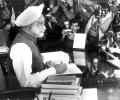
'The critical event signalling a new era for India was Dr Singh's 1991 Budget in which he quoted Victor Hugo to say that no power on earth could stop an idea whose time has come,' recalls T N Ninan.

The gross tax revenues have touched 65 per cent of the Budget estimates at Rs 17.81 lakh crore during the first eight months of the current fiscal till November, propelled by corporate and personal income tax mop-up, according to the Economic Survey 2022-23 presented in Parliament on Tuesday. The survey, authored by Chief Economic Advisor V Anantha Nageswaran, said the 'substantial reforms' in India's taxation ecosystem post-2014 and policy reforms have removed the distortionary incentives from the economy. Reforms like GST, reduction in corporate taxes, exemption of sovereign wealth funds and pension funds from taxes, and removing Dividend Distribution tax have reduced the tax burden on individuals and businesses.

Announcing a Re 1 crop insurance scheme for farmers, the deputy CM said the government will bear the financial burden of Rs 3,312 crore.

The government has revised gold import data, bringing down numbers for November by $5 billion to $9.84 billion, possibly to rectify double accounting of inbound shipments. According to revised data of the commerce ministry arm Directorate General of Commercial Intelligence and Statistics (DGCIS), gold import numbers have been slashed since April 2024, revealing excess imports of about $11.7 billion during the first eight months of 2024-25.

India's merchandise exports dipped by about one per cent to $38.01 billion in December 2024 against $38.39 billion a year ago, according to government data released on Wednesday. Imports increased by 4.8 per cent to $59.95 billion in December 2024 compared to $57.15 billion in the year-ago month.

The Nifty and Sensex traded close to their respective all-time highs.

Why has the shift from ICE to electric slowed down despite initial enthusiasm?
